






Why Queens Residents Need Reliable AC Repair
Queens stands as New York City's largest borough by area, home to over 2.4 million residents spread across 109 square miles. The borough's diverse housing stock—from pre-war apartment buildings in Astoria to modern high-rises in Long Island City—creates unique cooling demands that standard HVAC approaches cannot always address. Summer temperatures regularly climb into the high 80s and low 90s, with humidity levels that make indoor spaces uncomfortable without properly functioning air conditioning.
The infrastructure age compounds the challenge. Approximately 40% of Queens residential buildings were constructed before 1960, when air conditioning standards differed significantly from today's requirements. Many units still rely on window-mounted systems or outdated central air installations that strain under contemporary cooling loads. When these systems fail during peak summer months, the need for immediate professional intervention becomes critical rather than optional.
Queens apartment residents face particular constraints. Building management rules, shared wall considerations, and electrical system limitations all influence repair approaches. A technician who understands how to navigate co-op board requirements or work within rent-stabilized building regulations delivers value beyond basic mechanical skills. The borough's housing diversity demands technical flexibility that general contractors may lack.
Common AC Problems in Queens Properties
Window unit failures represent the most frequent service call category across Queens neighborhoods. These portable systems typically last seven to ten years with proper maintenance, yet many units operate well beyond their designed lifespan. Compressor burnout, refrigerant leaks, and failed capacitors account for 60% of window unit service requests during July and August. The constant vibration from subway lines and street traffic accelerates wear on mounting hardware and internal components, creating issues rarely seen in suburban installations.
Central air systems in Queens homes experience distinct failure patterns. The borough's variable housing density means outdoor condensing units often sit in tight spaces with restricted airflow. Backyards in Flushing and Forest Hills may measure only 15 by 20 feet, forcing condensers against walls or fences.
This proximity reduces heat dissipation efficiency and forces compressors to work harder. Technicians report that improperly sited outdoor units can lose 15-20% of their rated cooling capacity simply due to inadequate clearance. Many homeowners who invested in ac installation queens services years ago now discover that poor placement decisions created long-term efficiency problems.
PTAC units—packaged terminal air conditioners common in Queens apartment buildings—require specialized knowledge. These through-wall systems combine heating and cooling in a single chassis, popular in buildings from the 1970s and 1980s. When PTAC units fail, the problem often involves the exterior sleeve, drainage system, or wall penetration seal.
Generic repair approaches miss these building-specific elements. Approximately 30% of Queens apartment buildings use PTAC systems in at least some units, creating consistent demand for technicians who understand their unique architecture.
Ductwork issues plague split-system installations throughout the borough. Homes in neighborhoods like Bayside and Douglaston often added central air to existing duct systems originally designed for heating only. These retrofitted systems may have undersized return air paths or poorly sealed joints.
The result: rooms that never cool properly, high energy bills, and premature equipment failure. Proper diagnosis requires airflow measurement tools and duct pressure testing, not just equipment replacement.
The Same-Day Service Imperative
Medical research establishes clear thresholds for heat-related health impacts. When indoor temperatures exceed 82°F with moderate humidity, cognitive function declines measurably in adults. For elderly residents and young children, prolonged exposure to temperatures above 85°F creates genuine health risks. Queens has one of the highest concentrations of residents over 65 in New York City—approximately 16% of the borough population—making rapid AC restoration a public health concern during heat events.
The 2023 cooling season saw 12 days when New York City issued heat advisories. During these periods, emergency rooms across Queens reported 40% increases in heat-related admissions. Many patients came from homes with non-functional air conditioning. The data underscores why same-day repair availability matters beyond comfort considerations.
For vulnerable populations, working AC becomes a medical necessity, not a luxury amenity.
Business continuity drives commercial demand for rapid service. Queens hosts approximately 75,000 small businesses, from restaurants in Jackson Heights to professional offices in Forest Hills. When AC fails in a restaurant kitchen where ambient temperatures already reach 90°F, the business faces immediate closure under health code regulations.
Retail spaces lose customers when indoor conditions become uncomfortable. The economic impact of a 24-hour cooling outage can exceed the entire repair cost by a factor of ten.
Insurance considerations increasingly factor into response time expectations. Some property insurance policies now include provisions regarding reasonable maintenance response times for essential systems. Landlords in Queens apartment buildings who delay AC repairs beyond specified windows may face coverage complications if tenant property damage results from excessive heat. Documentation of rapid service response protects property owners from liability questions.
What Makes Queens HVAC Service Different
Building code variations across Queens create compliance requirements unfamiliar to technicians who primarily work in other boroughs or suburban areas. Queens follows New York City Construction Codes, but interpretation can vary by building age and occupancy type. Electrical work associated with AC repair must meet specific permit requirements when service upgrades are involved. Licensed contractors familiar with Queens-specific inspection protocols avoid costly reinstallation scenarios.
The borough's electrical infrastructure reflects its development history. Neighborhoods built before 1950 often have 60-amp or 100-amp service to individual dwelling units. Modern central AC systems drawing 30-40 amps on startup can stress these older panels.
Qualified technicians assess electrical capacity before recommending equipment, preventing installation of systems that will trip breakers or create fire hazards. This electrical expertise separates professional service from basic equipment swapping.
Refrigerant regulations have tightened considerably since 2020. The EPA's R-22 phaseout means older systems require either conversion to compatible alternatives or complete replacement. Queens has thousands of AC systems still using R-22, particularly in buildings constructed between 1995 and 2010.
Technicians must hold EPA Section 608 certification to legally handle refrigerants. They need current knowledge of drop-in alternatives, capacity adjustments, and lubricant compatibility. Weekend handymen lack these credentials and create legal liability for property owners.
Access logistics distinguish Queens service calls from those in less dense areas. Apartment buildings in Elmhurst or Rego Park may have loading dock restrictions, elevator reservations, and specific entry procedures. Technicians serving these properties need appropriate vehicle sizes, parking permits, and scheduling flexibility.
A service truck suitable for suburban calls may prove too large for Queens street parking. Companies familiar with urban operational constraints complete jobs more efficiently.
Choosing Qualified Technicians
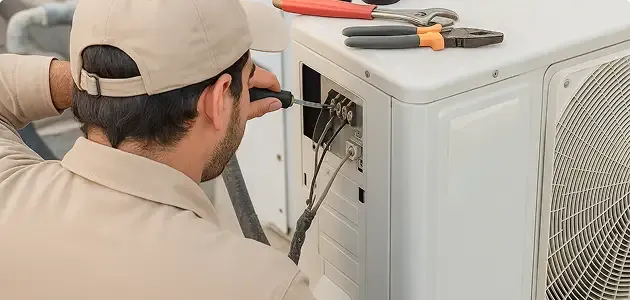
Licensing verification represents the first checkpoint when evaluating AC repair services. New York State requires HVAC technicians to hold licenses appropriate to their work scope. Master HVAC licenses indicate the highest qualification level, authorizing full system design, installation, and repair.
Journeyman licenses allow work under supervision. Unlicensed individuals may legally replace filters and thermostats but cannot work on refrigerant systems or electrical components. The state licensing database allows public verification of any technician's credentials and disciplinary history.
Insurance coverage protects property owners from liability. Legitimate HVAC companies carry both general liability and workers' compensation insurance. General liability covers damage the technician might cause to your property—a dropped condenser unit damaging a deck, for example.
Workers' compensation protects you if a technician is injured on your property. Queens property values make these protections essential. Request certificates of insurance before any work begins and verify them with the issuing carrier.
Pricing transparency separates professional operations from opportunistic ones. Reputable services provide clear diagnostic fees, hourly rates, and parts pricing before work commences. They itemize invoices showing labor hours, materials used, and any applicable taxes or fees.
Beware of providers who offer "free estimates" but then discover expensive problems only after arriving. Legitimate diagnostics have value and cost money, but those fees typically apply toward repair costs when you proceed with the work.
Equipment access matters for long-term value. Some repair companies use proprietary parts or systems that lock customers into single-source service relationships. This practice particularly affects PTAC units and certain mini-split systems.
Before considering ac installation queens projects or major repairs, ask whether replacement parts are available through multiple suppliers. Systems using standard components cost less to maintain over their lifespan.
Preventive Maintenance Economics
Data from HVAC industry studies shows properly maintained residential AC systems last 15-20 years, while neglected units average 10-12 years before replacement becomes necessary. The cost differential is substantial. A typical central AC replacement in Queens runs $5,000-$8,000 for a 2-3 ton system, while annual maintenance contracts cost $150-$300. The return on preventive maintenance investment approaches 20:1 over a system's lifetime.
Spring maintenance visits catch 70% of potential failures before they occur, according to trade association data. Technicians check refrigerant levels, clean condenser coils, verify electrical connections, and test capacitors—all common failure points. A $40 capacitor replaced during maintenance prevents a $400 emergency service call in July. Condenser coils cleaned in May improve efficiency by 10-15%, reducing electricity costs throughout the cooling season.
Filter management alone significantly impacts performance. Standard pleated filters require replacement every 30-60 days during cooling season, depending on household occupancy and pet presence. Clogged filters reduce airflow, forcing systems to run longer cycles to achieve set temperatures.
This extended runtime increases wear on compressors and blower motors. A $15 filter changed monthly can prevent $800 motor replacements.
Queens apartment buildings that implement maintenance contracts for their HVAC systems report 35% fewer tenant service calls during summer months. Scheduled maintenance visits identify worn components before complete failure, allowing planned repairs during moderate weather when technician availability is better and costs are lower. Building managers who budget for preventive maintenance avoid the budget surprises that emergency repairs create.
Energy Efficiency Considerations
Older AC systems operate at SEER ratings of 8-10, while current minimum federal standards require SEER 14 for new installations. High-efficiency units reach SEER 20 or above. The difference translates directly to operating costs.
A SEER 8 system cooling a 1,200 square foot Queens apartment might consume 3,600 kWh during a typical cooling season. The same cooling load with a SEER 16 system would use 1,800 kWh—a difference of roughly $360 annually at current Con Edison rates.
Payback calculations favor efficiency upgrades when replacement becomes necessary. A SEER 16 system might cost $800 more than a minimum-efficiency SEER 14 unit, but the $150 annual energy savings recover that premium in 5-6 years. Given that properly maintained systems last 15-20 years, the efficiency investment generates substantial net savings over the equipment lifespan.
Smart thermostat integration offers additional savings without equipment replacement. Programmable thermostats reduce cooling costs 10-15% by automatically adjusting temperatures when buildings are unoccupied or during sleeping hours. Newer Wi-Fi thermostats learn usage patterns and can integrate with weather forecasts to optimize runtime. Installation typically costs $200-$400 including the device and labor, with payback periods under three years for most households.
Zone cooling strategies make particular sense in Queens' varied housing stock. Many homes cool spaces that receive little use—guest bedrooms, formal dining rooms, or finished basements. Mini-split systems allow cooling only occupied areas, reducing total capacity requirements.
A home that might need a 4-ton central system for whole-house cooling could use a 2.5-ton mini-split setup focused on bedrooms and main living areas, cutting installation and operating costs substantially. Professional contractors evaluate zone cooling options based on your home's specific layout and usage patterns, bringing the same expertise they apply to ac installation queens projects throughout the borough.
Seasonal Demand Management
Queens HVAC companies experience demand spikes that strain capacity. The first heat wave of each summer—typically late June—generates service call volumes 300% above baseline levels. During these peaks, wait times extend from same-day to 2-3 days even for established customers. Strategic scheduling avoids these bottlenecks.
Spring maintenance completed in April or early May ensures systems are ready before peak demand begins.
Emergency service surcharges reflect supply and demand reality. After-hours calls—evenings, weekends, and holidays—typically carry premiums of 1.5x to 2x standard rates. A repair that might cost $400 on a Tuesday afternoon could reach $700 on Saturday evening. Non-emergency situations benefit from waiting for standard business hours, but true emergencies justify the premium cost.
Parts availability fluctuates seasonally. Capacitors, contactors, and compressors stock out during peak summer demand, particularly for older equipment models. Technicians may need to special-order components with 2-3 day lead times during July and August. Spring or fall repairs proceed more quickly because distributors maintain fuller inventories when demand pressure is lower.
Equipment pricing follows similar patterns. HVAC manufacturers offer promotional pricing during shoulder seasons—April through May and September through October. Replacement systems installed during these windows can cost 10-15% less than identical equipment installed during peak summer months.
For situations where repair costs approach 50% of replacement cost, timing the replacement strategically generates significant savings. Spring represents the optimal window for ac installation queens projects when contractor availability and pricing both favor customers.
Making the Service Call
Clear communication accelerates diagnosis. When calling for service, note specific symptoms: whether the system runs but doesn't cool, whether it short-cycles, whether ice forms on refrigerant lines, or whether airflow seems weak. This information helps technicians bring appropriate tools and parts on the first visit. A compressor failure requires different equipment than a blower motor problem.
Access preparation speeds service completion. Ensure technicians can reach both indoor and outdoor components. Clear paths to basement equipment rooms, unlock roof access if condensers are roof-mounted, and notify building management if elevator use or loading dock access is required. Service calls delayed by access issues still incur minimum charges for the technician's time.
Decision authority at service time prevents delays. Repairs often require on-site approval when technicians discover problems beyond the initial symptoms. Having the decision-maker present or immediately available by phone allows work to proceed. Delays for landlord approval or spouse consultation extend what might be a two-hour repair into a multi-day project.
Payment policies vary but moving toward card-preferred models. While many Queens HVAC companies traditionally accepted checks, card processing now represents the norm for same-day payment. Some offer modest discounts for immediate payment while others charge premium rates for invoiced terms. Clarifying payment expectations during scheduling prevents awkward conversations after work completion.
Queens' unique position as New York City's most diverse and geographically expansive borough creates AC repair demands that require local expertise, rapid response capability, and technical depth beyond what general contractors provide. The combination of aging housing stock, vulnerable populations, and infrastructure constraints makes professional HVAC service essential rather than optional during the region's increasingly warm summers. Whether you need emergency repairs or are considering ac installation queens options for enhanced cooling capacity, working with qualified local technicians who understand the borough's specific challenges ensures reliable cooling when you need it most.


