
AC blowing hot air
When cool air stops: capacitor, refrigerant charge, thermostat wiring and controls.
Hot air fixAn AC that will not cool in an NYC apartment usually falls into one of five categories: no power, no signal, no airflow, no refrigerant, or no compressor. This guide walks through the checks a technician runs and the checks you can safely do yourself before calling. Call (212) 201-9201 if the problem is beyond a thermostat, filter or breaker.
Certification and license records are available on request while our public verification page is in progress.
A blank display often means a dead battery, a tripped float switch on the drain pan, or a low-voltage transformer that has failed.
Both the indoor and outdoor units usually have their own breakers. A tripped breaker that resets and holds may just have nuisance-tripped; one that trips again is a fault.
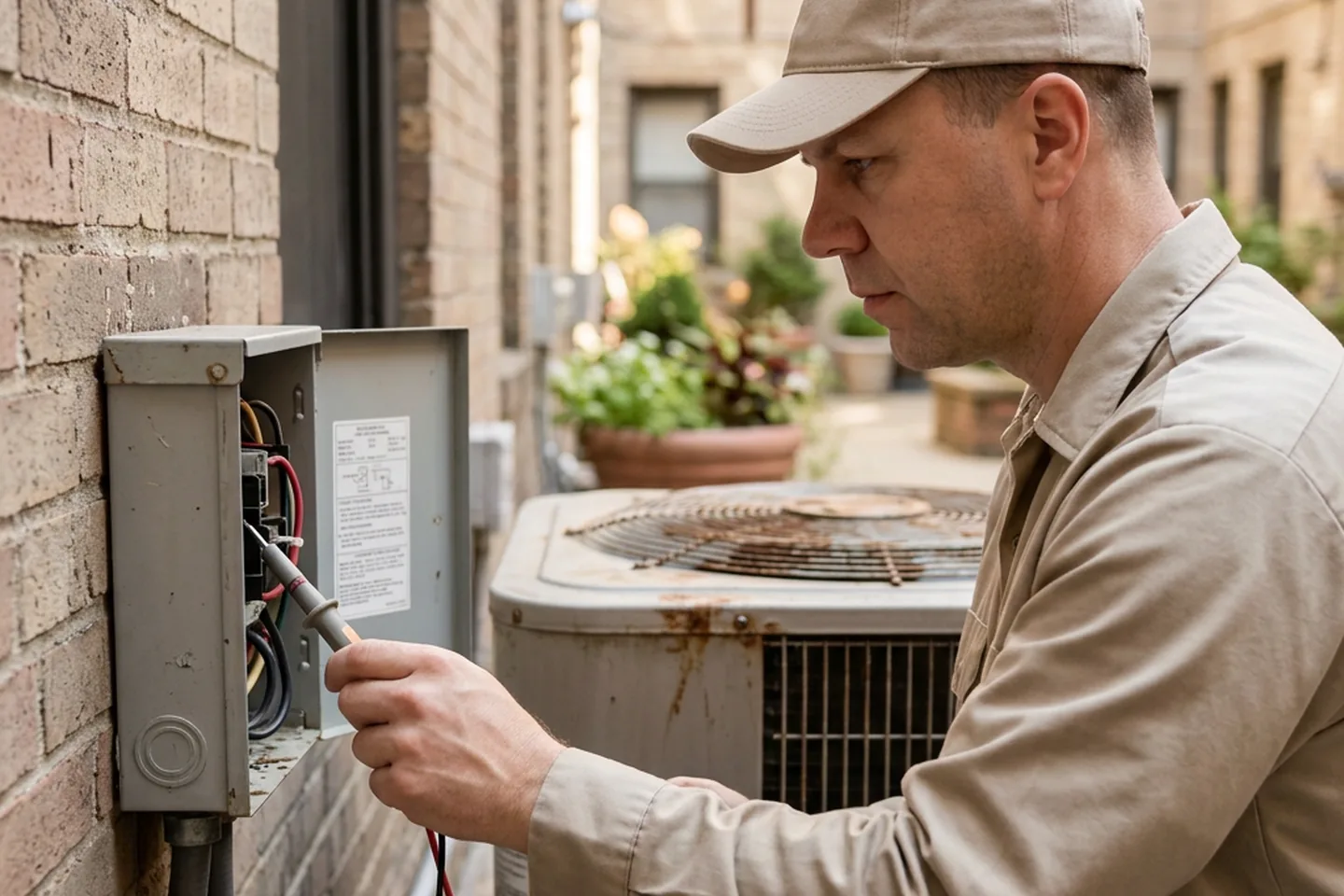
Outdoor units have a service disconnect near the condenser. Confirm the pull is fully seated and the fuses inside are intact.
Set the thermostat to cool and lower the setpoint five degrees below the current room temperature. Wait two minutes: modern systems have a compressor delay. Listen for the outdoor unit starting. If nothing happens, the thermostat wiring, the float switch on the condensate pan or the low-voltage transformer are the usual suspects.
Pull the return-air filter. A filter that is fully loaded stops the system from moving enough air, ices the coil and eventually shuts the compressor down on a safety limit. Replace it, wait 24 hours for any ice to melt, and try again. In pre-war NYC apartments where the filter grille is behind a bed or bookcase, this is the most-missed fault.
If the outdoor unit runs but the indoor supply air is only slightly cool, and the outdoor coil is caked with fluff or the fins are crushed, cooling capacity is choked. Once you have vacuumed and cleaned the coil, the system should recover. If capacity does not return, the refrigerant charge is low, which means a leak somewhere in the system and a technician with EPA 608 certification.
A humming compressor that never starts is a classic bad run capacitor. The outdoor fan may also be affected on a shared capacitor.
Compressor amp draw compared with nameplate is the technician's measurement. Locked-rotor amps sustained for more than a second or two are what trips the breaker.
A pitted contactor sometimes closes and sometimes not, giving intermittent cooling that is worst on hot days.
Check the thermostat first, then the breakers for both the indoor and outdoor units, then the outdoor disconnect, then the filter. Those four checks resolve the majority of no-cool calls we take from NYC apartments.
Almost always a failed capacitor, sometimes a seized fan motor. A capacitor is a $220 to $450 job in NYC; a fan motor is $350 to $700 depending on brand and access. Neither is safe to open live.
Weak airflow with cool but not cold supply is either a dirty filter, a choked or iced evaporator coil, or a failing blower motor. Replace the filter and give the system 24 hours to thaw before deciding a technician is needed.
No, and it is not legal without EPA 608 certification. Adding refrigerant to a leaking system without finding and fixing the leak is a code violation and a warranty voiding move. Call a certified technician.
A business-hours diagnostic in NYC runs $150 to $300 and is credited toward the repair when approved on the same visit. After-hours diagnostics are $250 to $400. Prices are stated on the phone before dispatch.
When cool air stops: capacitor, refrigerant charge, thermostat wiring and controls.
Hot air fixWater on the floor around an AC: drain pan, drain line, sleeve tilt and pump failures.
Leak diagnosisWhat a diagnostic, a capacitor swap and a refrigerant leak actually cost in New York.
PricingFully down in a heatwave? Line answered 24 hours for real emergencies.
Report the fault before mid-afternoon and we dispatch the same business day.
Call (212) 201-9201 or send the symptom, building type and equipment through the quote form.