
AC blowing hot air
How to separate an airflow problem from a true cooling failure.
Read the guideIce on AC coils is a stop-and-check symptom. Shut cooling off first, let the coil thaw, and use the observations in this guide to help a technician find the airflow, refrigerant, or control problem behind it.
Certification and license records are available on request while our public verification page is in progress.
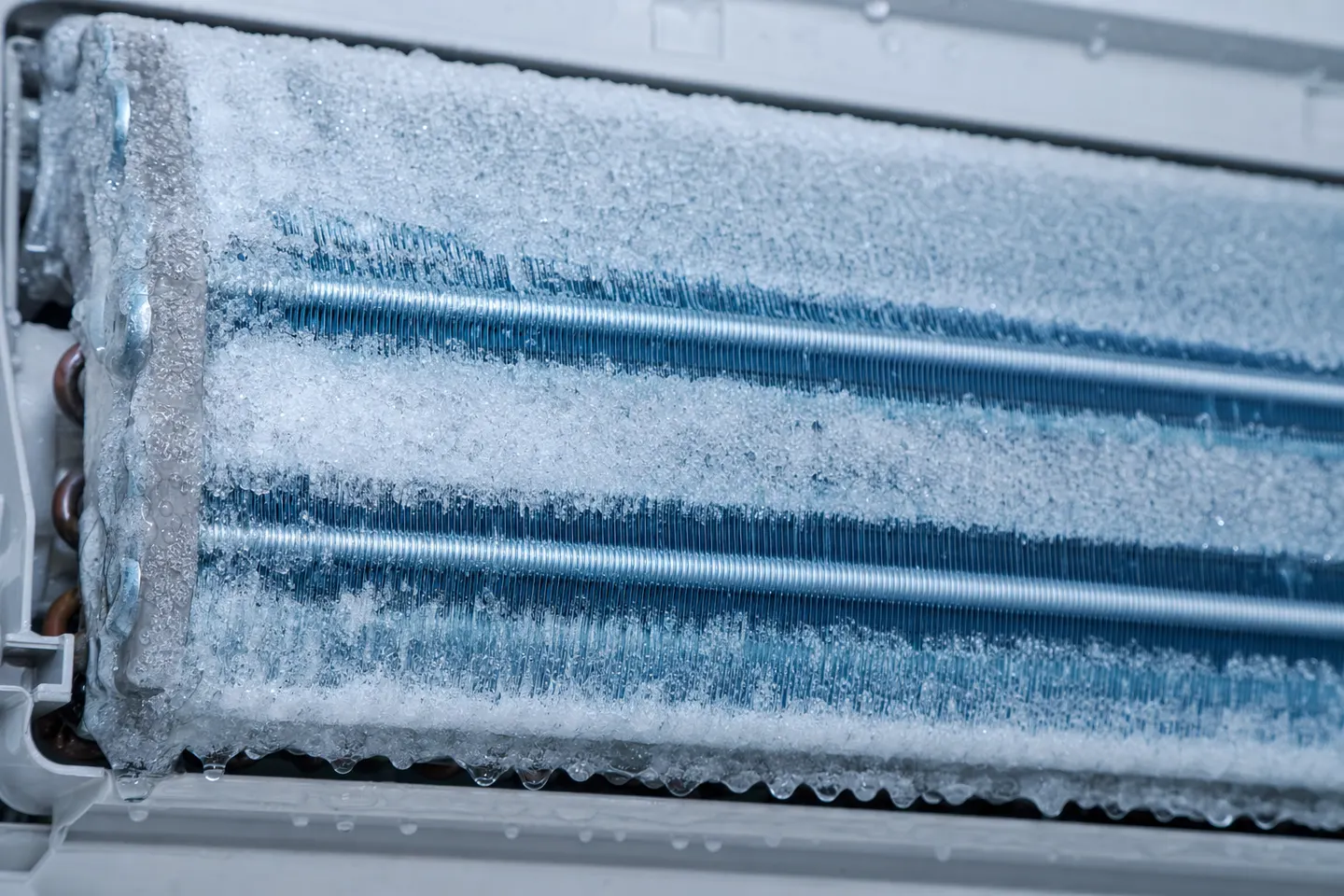
Ice on an evaporator coil, refrigerant line, or indoor unit is not a sign that the AC is “extra cold.” It means the coil surface has fallen below freezing and moisture is freezing instead of draining. Continuing to run it can flood a ceiling or damage the compressor when liquid refrigerant returns. Use the thermostat to turn cooling off; if the indoor fan can run independently without the compressor, it may help thaw the coil, but do not force the unit back into cooling.
For central AC repair cases involving a frozen coil, we start with the condition after thawing because ice hides the evidence. Depending on humidity and coil size, complete thawing can take several hours. Put towels below a safe, accessible indoor unit only if water can be caught without reaching wiring; report a ceiling leak or wall saturation to building staff immediately.
Do not chip ice with a screwdriver, pour hot water into the cabinet, remove sealed panels, or add refrigerant. Bent coil fins, water near controls, and incorrect refrigerant charge all make a simple symptom more complicated.
After the cooling cycle is off, look for a loaded filter, blocked return, closed supply registers, or an indoor blower that is not moving air. Photograph the ice before it melts, then note whether it began at the indoor coil, the larger insulated suction line, or a ductless head. Those observations help the technician plan the first test.
A clean filter and open grilles do not rule out airflow trouble. The coil may be dirty behind the filter, a blower wheel can be coated with dust, or a motor/control can be weak. In a PTAC or window unit, a curtain, furniture, or a partly installed front panel can also recirculate air and reduce proper airflow.
If a renter sees water traveling into a wall, ceiling, or outlet, make that a building-management priority. A freeze-up can create a moisture condition beyond the AC repair, and early documentation helps a landlord or co-op address finishes and drainage.
Low airflow is the most common path to a frozen indoor coil. The refrigerant is still absorbing heat, but too little warm room air reaches the coil. Coil temperature falls below 32°F, moisture freezes, and the accumulating ice blocks even more air. It is a feedback loop, not a lack of maintenance alone.
Technicians check the filter, blower speed, blower amp draw, return and supply restrictions, duct static pressure when applicable, and the coil face after it has thawed. On older fan coils tucked above pre-war apartment ceilings, access panels can be small and the coil may be overdue for professional cleaning. On a ductless head, a dirty blower wheel is often as important as a dirty filter.
The repair may be as simple as restoring airflow, or it may involve cleaning the coil, correcting a blower control issue, replacing a weak motor, or finding a duct problem. Running with a frozen coil until it “recovers” masks rather than solves the cause.
A refrigerant leak can reduce pressure and lower coil temperature enough to freeze moisture even when the filter looks clean. The system may cool weakly before it freezes, or it may begin icing shortly after a long run. Oil residue near a flare, brazed joint, coil, or service port is one possible clue, but a leak cannot be confirmed by appearance alone.
In Brooklyn brownstones and apartment buildings we visit, concealed line-set runs through masonry, chases, and rear yards can complicate the leak search. A 12-story vertical stack can create access and scheduling issues as well. The technician needs system-specific pressure, temperature, and electronic leak-search evidence after verifying airflow.
Refrigerant is not a do-it-yourself consumable. R-22 is legacy refrigerant and can be especially costly; newer R-32 equipment has its own manufacturer requirements. A proper estimate identifies the leak-search scope, the repair feasibility, and the charge procedure rather than promising a permanent cure from a top-off.
A blower that intermittently slows, a mis-set fan speed, a failing metering device, or a condenser that cannot reject heat can contribute to abnormal operating conditions. On mini-splits, sensor and inverter faults can change the refrigeration cycle in ways that are not visible at the wall head. A technician reads fault history when the system provides it and checks both indoor and outdoor operation.
Some freeze-ups begin after renovation or replacement work: a return is undersized, a new high-efficiency filter is too restrictive for the blower setting, or refrigerant piping was altered. The right remedy is not chosen from ice alone. The measured airflow, superheat/subcooling where applicable, electrical performance, and installation condition have to agree.
If the outdoor unit is in a locked yard, on a roof, or behind a window barrier, tell the dispatcher. Co-op elevator windows, superintendent access, and roof keys affect whether the complete diagnosis can happen in one trip.
A pre-war walk-up may have a fan coil above a bathroom ceiling, while a newer doorman building has an outdoor condenser on a controlled roof. The tenant sees the same ice; the technician sees different access, drainage, and approval paths. Building staff can help by confirming equipment location, water shutoff procedures, and permitted work hours.
For emergency conditions such as active water damage, no cooling during a health-sensitive heat event, or a system that will not shut down, describe that clearly. The emergency line is answered 24 hours. For a standard freeze-up after the unit is safely off, scheduling after a full thaw allows more accurate readings and reduces the chance of a return visit.
Commercial systems deserve a separate note. A tenant space may have rooftop equipment tied to building rules and Local Law 97 energy planning, but ice is still an equipment symptom first. Diagnose the airflow, charge, controls, and drain condition before treating it as an energy project.
After thawing, the technician confirms thermostat behavior, filter condition, return/supply paths, blower operation, coil cleanliness, condensate drainage, outdoor fan/compressor sequence, and system temperatures. Refrigeration readings come after airflow is verified because bad airflow can make pressure readings misleading.
If low charge is suspected, the technician searches for the leak and evaluates accessible joints and coils. If airflow is the issue, the job may include a coil or blower cleaning, motor/control testing, or duct evaluation. A drain issue can be addressed at the same visit, but a clogged drain alone does not usually create coil ice; it may be a consequence of the thaw.
Most accessible diagnostics take about 45–90 minutes. A concealed coil, roof condenser, or extensive leak search can need more time. Ask for the observed cause, the measurements taken, and what must be corrected before the AC is restarted.
A diagnostic commonly runs $150–$300 during business hours. Common corrective ranges include about $250–$550 for professional coil cleaning, $450–$900 for a blower motor, $400–$1,200 or more for leak search and repair before refrigerant, and $250–$500 for a condensate pump if drainage is also failing. Access, equipment brand, and refrigerant affect the estimate.
If a system repeatedly freezes because of a major coil leak or has obsolete R-22 equipment, compare a repair with a replacement plan. In a co-op, that plan may include board documentation, line-set routing, noise rules, and installation hours. The cheapest first invoice is not always the lowest-cost outcome if the system will freeze again in weeks.
A technician should explain what is confirmed, what is suspected, and what part of the estimate is diagnostic versus repair. That clarity matters when a managing agent, owner, or board must authorize the next step.
Use the right filter and change it before it is loaded. Keep returns and supply openings clear, do not operate a unit with known weak airflow, and schedule professional maintenance that includes coil condition, drain function, and electrical checks. A room that has been renovated around a return grille deserves an airflow review before peak season.
If a unit froze once, do not assume replacing a filter completed the repair. Track whether the system reaches set point, whether ice returns, and whether water appears after long cycles. Early service is far simpler than a late-night ceiling-water report.
Maintenance reduces risk but does not make a sealed-system leak disappear. Persistent icing after the easy checks calls for measured diagnosis, not another restart.
Once the ice has melted, do not treat a few minutes of cool air as proof that the fault disappeared. A restricted system or a low-charge system can cool briefly and freeze again under a longer humid load. Tell the technician how much ice you saw, whether the blower was still moving air, and whether a filter was replaced. Those details help separate a one-time restriction from a condition that has been building for weeks.
The service note should explain the test order. Airflow needs to be confirmed before refrigerant readings are interpreted, because a dirty coil or weak blower can make the pressure picture look like a charge problem. If a leak is suspected, ask what evidence supports it and whether all accessible joints and coils were evaluated. A temporary charge without a leak finding is not a durable repair plan.
In a building with a ceiling fan coil or roof condenser, confirm who will provide future access if a follow-up is needed. A thawed unit can appear normal when the technician arrives unless the history, photos, and access plan are clear. That preparation can prevent a second visit that only repeats the same initial observations.
Turn cooling off and let the coil thaw completely. Do not chip the ice or restart the system repeatedly. Check only safely accessible filter and airflow items, then arrange a diagnosis.
If the thermostat has a fan-only setting and the indoor fan operates normally, it can help thaw the coil. Do not run cooling until the cause has been diagnosed.
It may help if a blocked filter caused low airflow, but freeze-ups can also come from a dirty coil, blower fault, refrigerant leak, or metering problem. The system should be checked if ice returns.
Several hours is common, depending on coil size, humidity, airflow, and the amount of ice. Do not schedule a performance test while the coil is still encased in ice.
No. Frost or ice on the larger insulated line during cooling often indicates an operating problem such as low airflow or low refrigerant charge and should be diagnosed.
Yes. A leak can lower coil temperature enough to freeze moisture. Refrigerant should not be added without finding and addressing the leak.
Yes. As the ice melts, a drain pan or condensate path can overflow. Report active ceiling, wall, or outlet moisture to building staff immediately.
How to separate an airflow problem from a true cooling failure.
Read the guideWhat to do when condensate appears at the unit, ceiling, or wall.
Read the guideA broader symptom-by-symptom troubleshooting path.
TroubleshootingMeasured diagnosis for coils, blower systems, condensers, controls, and refrigerant circuits.
For urgent no-cool or water-risk conditions; the emergency line is answered 24 hours.
Preventive visits that check filters, coils, drains, and electrical components.
Call (212) 201-9201 or send the symptom, building type and equipment through the quote form.