
AC service cost NYC
Diagnostic fees and common repair ranges before you compare a repair with a replacement.
Read cost guideA $5,000 repair is not automatically a replacement decision. In New York, access, refrigerant, system age and a building’s installation rules can change the answer. This 2026 guide applies a practical repair-versus-replace test to central AC, ductless systems, PTACs and window units.
Certification and license records are available on request while our public verification page is in progress.
The “$5,000 rule” is a shorthand: if a single repair is about $5,000, stop and compare it with replacement. It is useful because a new system carries a new parts warranty, a predictable efficiency level and a known remaining life. It is not a New York City rule, a manufacturer rule or a reason to replace a unit that has a cheap, durable fix.
A better starting point is the 50% test. Compare the complete repair estimate with the installed price of the like-for-like new system, including access, electrical, permits where needed and removal. When a repair reaches roughly half of replacement cost, replacement deserves a written comparison. A $1,100 fan motor on a $9,000 ductless replacement is usually a repair. A $5,200 compressor on a $9,500 system with a second known leak is a different conversation.
For a failed system, a measured diagnostic comes first. The same method used on our residential AC repair visits identifies whether the charge is for the failed part alone or a symptom of a larger refrigerant, airflow or electrical problem.
Installed mid-market licensed-contractor prices in 2026 are typically $6,500–$14,000 for a central AC replacement where ductwork is usable; $4,500–$18,000 for ductless mini-splits, depending on zones and line-set routing; $1,600–$3,200 for a PTAC; and $250–$700 for a properly supported window unit. Those ranges are installed numbers, not an online equipment-only price.
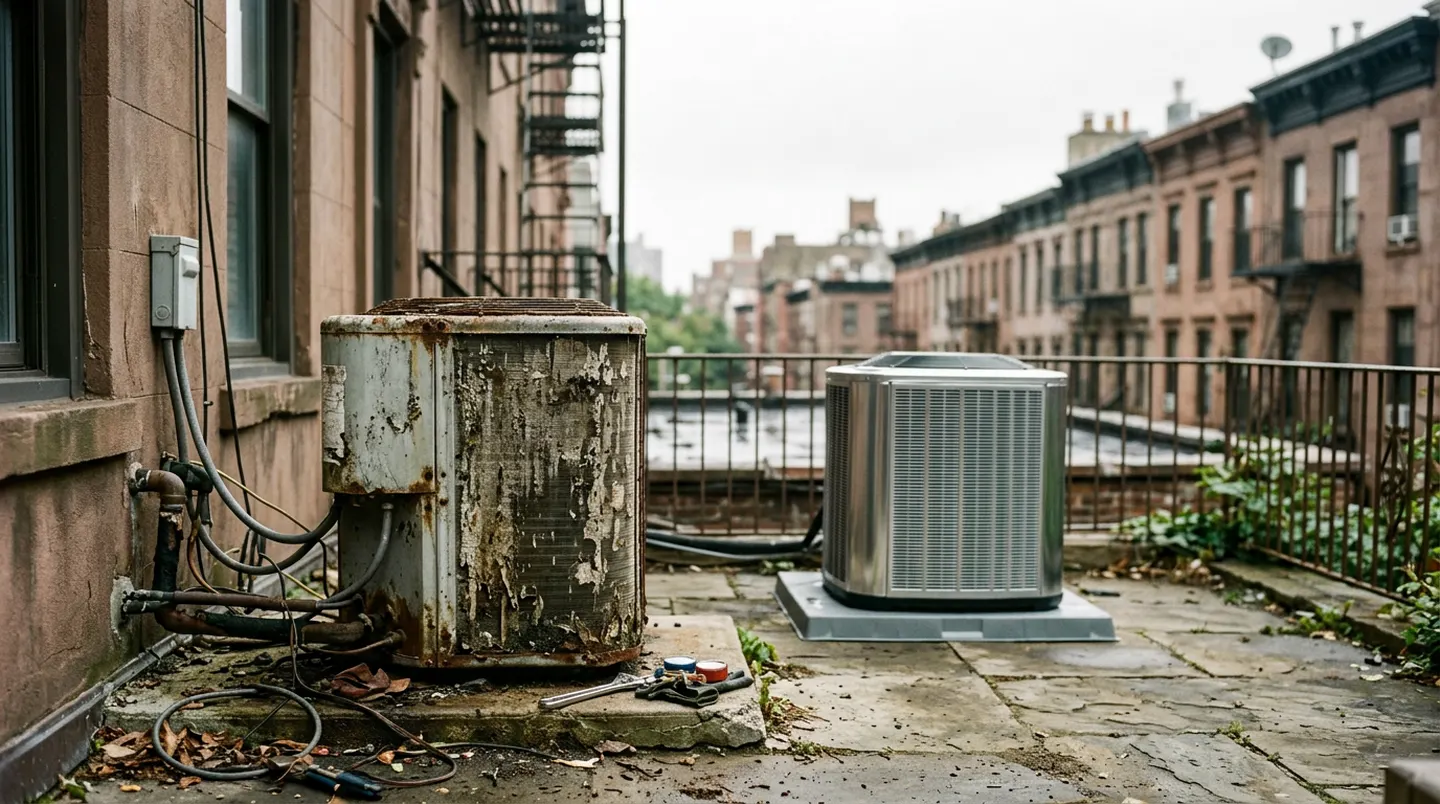
NYC installation estimates are higher when a condenser needs a roof route, a crane, a structural stand, after-hours elevator coordination, a new breaker or a co-op certificate of insurance. A brownstone rear-yard condenser is usually simpler than a terrace condenser subject to board rules. In a Manhattan building, access planning can be the deciding cost even when the equipment price is ordinary.
Capacitors, contactors, condensate pumps, standard thermostats and blower motors commonly fall in a repair-first range. In NYC, a capacitor or contactor repair often runs $220–$450; a condensate pump $250–$500; a blower motor $450–$900. A clean coil and a corrected drain issue can restore capacity without changing the system.
Repair is also sensible on a younger R-410A or R-32 system with documented service history. A technician should verify voltage, amp draw, temperature split, static pressure where applicable and refrigerant performance before calling a compressor bad. Replacing a compressor because a condenser coil is matted with debris is not sound diagnosis.
Not every $5,000 estimate means replacement. A high-capacity commercial split system may cost $25,000–$45,000 to replace once engineering, curb work, controls and tenant access are included. A $5,000 compressor repair on that system can be a sound business decision if the coil tests clean and the equipment is otherwise in good condition.
Another exception is a historic or constrained façade. If an approved condenser location is difficult to reproduce, replacement can involve landmark review, board approval or a new route. In that situation, document the repair option and get a separate proposal for the physical work required by a new outdoor unit.
A system with R-22 deserves a more conservative replacement conversation. R-22 is no longer made or imported for new production in the United States, so recovered or reclaimed supply and leak history affect a repair’s value. Paying to locate and repair one accessible leak may still be reasonable; repeatedly adding refrigerant without identifying the leak is not.
For R-410A and R-32 equipment, refrigerant is not a normal consumable. A low charge is a diagnostic question. Ask where the leak was found, how it was repaired, whether the system was evacuated and weighed back in, and what warranty applies to that repair. Those details matter more than a one-line “recharge” price.
The proposal should separate equipment, labor, electrical work, permits or filing allowance, condensate management, line-set route, equipment pad or brackets, haul-away and access. A cheap online condenser is not a permitted, supported, commissioned installation. A co-op may also require vendor insurance, a deposit, elevator reservations and a work-hour window.
If the system is being replaced rather than repaired, our AC installation team can scope the access and electrical conditions before a decision is made. That comparison is particularly important for multi-zone mini-splits, where a “one head failed” complaint can trace to branch controls, wiring or a shared outdoor unit.
A newer system can lower electricity use, but savings should not be used to justify any replacement at any price. Compare comparable capacity, actual run hours, utility rate and the seasonal efficiency rating. In a shaded apartment used only at night, the operating savings may be modest. In a restaurant or sun-exposed top-floor unit that runs for long hours, the gain can be more meaningful.
Con Edison incentives and federal or state programs change over time and have eligibility rules. Treat a rebate as a potential offset only after the equipment, contractor and application pathway are confirmed. Do not sign a replacement contract based on an assumed rebate that has not been reserved or verified.
A useful recommendation states the diagnosed fault, the repair price, what the repair does and does not address, the replacement alternative, expected access work, warranty terms and the reason the technician favors one path. It should also say when there is insufficient evidence to make a replacement recommendation.
The correct answer is sometimes “repair it and revisit later.” It is sometimes “replace it before a second major repair.” The $5,000 rule earns its place because it makes that conversation concrete, not because it replaces professional diagnosis.
Example 1: central AC in a small brownstone. A 12-year-old central system has a failed blower motor and a worn capacitor. The repair is $1,050, the outdoor coil is clean, electrical readings are normal and there is no refrigerant issue. A comparable central replacement is quoted at $10,500 because it includes access and a new condensate pump. The repair is about 10% of replacement and does not point to an impending sealed-system failure. Repairing, then budgeting for future replacement, is the measured choice.
Example 2: ductless system with a compressor and leak history. A 14-year-old two-zone system has lost charge twice, one indoor head has intermittent communication alarms and the outdoor compressor has now failed. The estimated repair is $4,800 after leak work and commissioning. A two-zone replacement is $10,200, including a revised line-set route. The repair is near 47% of replacement and leaves aging electronics and prior leak history in place. Replacement has a stronger case, but the owner should still compare route, permit needs and exterior approval before signing.
Example 3: PTAC in a co-op. A PTAC has a failed board for $520. A new chassis is $2,250 installed, but the sleeve and grille are in good condition. The repair is about 23% of replacement, so board replacement is reasonable if the chassis is otherwise cooling and heating correctly. If the sleeve is corroded or the unit has multiple seasons of water damage, the installation scope changes and so does the answer.
These examples are not price promises. They illustrate why a technician should compare a complete repair with a complete replacement, not compare an invoice against the lowest equipment price online. Capacity, access, documented condition and the repair warranty are all part of the value. For owners, the most useful question is: “If I approve this repair, what known risks remain?”
Keep copies of the diagnosis, estimates and equipment information. A serial number, installation date, prior refrigerant repair and board correspondence can make a future decision faster and reduce pressure when the first hot week of summer arrives. A deliberate repair can be the right short-term decision; it should not prevent a building from planning a well-scoped replacement later.
Owners should separate a repair decision from frustration with a breakdown. Start with the technician’s measured findings, then list the age, model, refrigerant, prior repairs and the quoted repair warranty. Get the installed replacement number for comparable capacity, including the access and building work that would actually be needed. This creates a useful record for a homeowner, a co-op board or a commercial manager; it also prevents an old but reliable system from being discarded because one summer call felt expensive.
Next, identify the consequences of waiting. If the part is available, a repair may buy a year or several years of normal service. If it is a legacy compressor, an obsolete board or a repeat leak with limited refrigerant supply, the wait can increase the chance of a forced replacement during peak season. That does not make replacement mandatory today. It means the owner should decide whether the short-term repair is paired with a reserve budget, building approval work or a design review for a future system.
For buildings, compare occupant impact as well as invoices. Replacing a central condenser may require roof access, tenant notices and a planned shutdown. Repairing it may take a shorter window but leave a known reliability concern. A multi-zone ductless replacement can require access to several apartments. Put the expected disruption on the proposal beside the cost and warranty, especially if the work will touch a lobby, terrace, roof or landmark-facing wall.
There is also a timing question. An October replacement quote can be easier to schedule than a July emergency installation, when access crews and equipment are scarce. If the repaired system is operating safely, a board can use the off-season to obtain approvals and compare technical options. The outcome is not necessarily the lowest price; it is a system decision with known scope, predictable access and fewer avoidable changes after work begins.
No. It is a comparison trigger, not a universal rule. Compare the specific repair with the installed replacement cost and account for age, warranty, refrigerant and access.
Not on age alone. A 10-year-old system with an isolated electrical repair can be worth fixing. A 10-year-old system with a compressor failure, leaking coil and poor performance warrants a replacement comparison.
It may restore cooling temporarily, but refrigerant does not disappear in normal operation. The valuable repair is finding and correcting the leak, then evacuating and charging the system correctly.
It should identify equipment capacity and efficiency, labor, access, electrical or condensate work, permit or filing allowance when applicable, removal, warranty and exclusions.
Yes. Board approval, insurance requirements, elevator hours and approved condenser locations can add time and cost to replacement, and should be priced before comparing options.
Diagnostic fees and common repair ranges before you compare a repair with a replacement.
Read cost guideCompare the two retrofit paths for apartments, brownstones and mixed-use buildings.
Compare systemsSizing and equipment choices that fit NYC apartments.
Buying guideMeasured diagnosis and a written repair recommendation.
Replacement scoping for central, ductless, PTAC and window systems.
Multi-zone and single-zone replacement planning.
Call (212) 201-9201 or send the symptom, building type and equipment through the quote form.