
AC blowing hot air
How to separate an airflow problem from a true cooling failure.
Read the guideAn AC that starts and stops every few minutes is not behaving normally. Time the pattern, make the safe checks, and use this guide to understand the thermostat, airflow, drainage, outdoor, and refrigerant causes.
Certification and license records are available on request while our public verification page is in progress.
Short-cycling means the AC starts, runs briefly, shuts down, and repeats before it has completed a normal cooling cycle. A cycle of roughly 3–5 minutes is a common warning pattern, but the correct cycle length varies with load, system size, thermostat location, and equipment type. The problem is not just annoying: repeated starts can increase wear and prevent stable dehumidification.
Across central AC repair calls in NYC, we separate a thermostat command from the reason the equipment obeyed or stopped. The cause may be oversized capacity, poor airflow, a dirty coil, refrigerant issue, condensate safety switch, electrical/control fault, outdoor overheating, or a room condition that fools the thermostat.
The resident’s job is to note the pattern, not to force longer cycles. If there is ice, water leak, burning smell, breaker trip, loud noise, or a system that will not shut down, turn cooling off and arrange service.
Set the thermostat to COOL and choose a set point 3–5°F below room temperature. Then time three cycles: when the indoor blower starts, whether the outdoor unit starts, when cooling stops, and whether the fan continues. Note the room temperature and whether sunlight, cooking, or an open window is affecting the thermostat location. Do not open electrical panels or bypass a float switch.
Check a safely accessible filter, confirm returns and supply openings are clear, and look for water, ice, or fault codes. A filter can be replaced if it is visibly loaded and you have the correct size. Do not keep resetting a breaker or restarting an iced system; those actions obscure a useful pattern and can damage equipment.
In a co-op or doorman building, note any restrictions on roof, terrace, or mechanical-room access. A complete diagnosis often needs to observe the indoor equipment and the condenser during the same short cycle.
A thermostat in direct sun, near a kitchen, above a supply register, or close to a draft can sense the wrong temperature and end a call for cooling early. Smart thermostat schedules and sensor settings can also create an apparent short cycle. The technician verifies the control call and compares it with room conditions before blaming the equipment.
An oversized system can cool the thermostat location too quickly without removing enough moisture from the apartment. This is common after an uncalculated replacement or when a smaller pre-war apartment has changed layout and insulation. Oversizing is not proven by cycle length alone; a load and airflow review is needed before calling replacement the solution.
A thermostat replacement may fall around $180–$520 installed, but it is a waste if the actual issue is airflow, refrigerant, or a safety switch. The service report should state whether the thermostat ended the call or whether the equipment shut itself down.
A blocked filter, dirty evaporator coil, weak blower, or closed return can cause the coil to get too cold. As ice forms, the system loses capacity and may trip a protection or behave erratically. Some systems also shut down on a high-temperature or low-pressure condition created by airflow trouble.
Technicians check filter condition, blower speed and amp draw, coil cleanliness, return and supply path, and drainage. A filter correction can be straightforward; a dirty coil or blower wheel inside a concealed pre-war fan-coil cabinet takes professional access and cleaning. Do not close vents to force more cooling into one room, because that can raise resistance and worsen the condition.
If ice is visible, turn cooling off and allow it to thaw. Refrigeration measurements taken through a frozen coil can mislead the diagnosis. Once airflow is confirmed, the technician can evaluate the refrigerant circuit accurately.
Low refrigerant from a leak, a dirty condenser coil, failed outdoor fan, or compressor overheating can cause a system to stop and try again after protections reset. On a hot roof, a condenser with poor airflow may run briefly, overheat, and cycle off. In a ductless system, inverter and sensor controls can create a similar complaint with different internal logic.
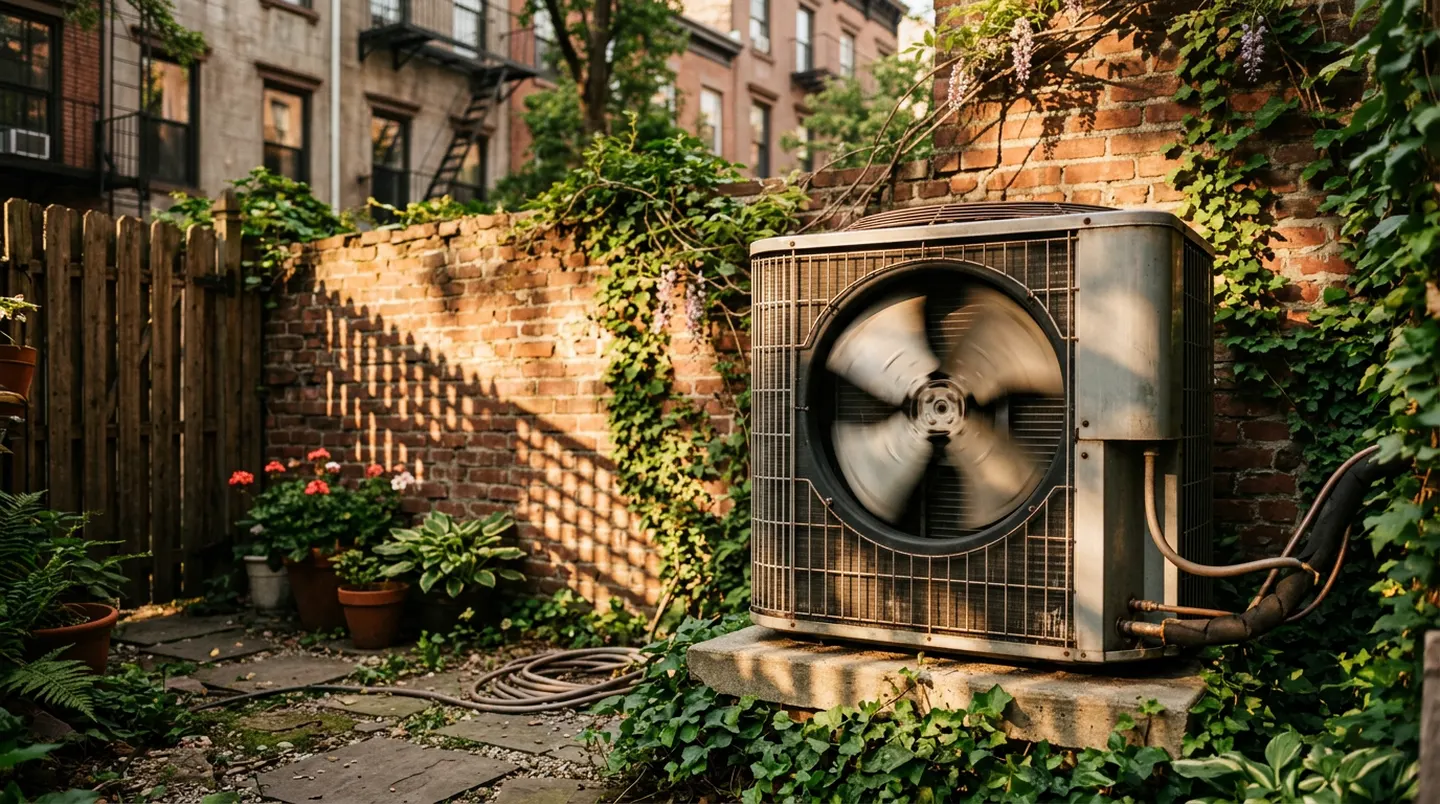
In Manhattan buildings with roof and terrace condensers, access and heat exposure can make this especially visible. Roof keys, elevator reservations, and safe work windows affect how quickly the outdoor condition can be measured. The diagnosis needs current draw, fan condition, temperature readings, coil condition, and system-specific refrigeration tests.
A refrigerant charge is not a guessed adjustment. If low charge is indicated, the leak must be located and repaired. R-22 systems need a careful cost discussion because the refrigerant is legacy product; R-32 systems must follow the manufacturer’s equipment-specific requirements.
A condensate safety float switch can stop cooling when a pan fills, protecting a ceiling or equipment area from overflow. A failing condensate pump, blocked drain, loose sensor, weak capacitor, contactor, or control board can also create a stop-start pattern. The pattern may be more obvious during humid weather when condensate production is high.
The technician checks pan and drain condition, pump operation, safety switches, control voltage, capacitor condition, and fault history. A condensate pump replacement commonly ranges about $250–$500; control components vary, but a capacitor or contactor often falls around $220–$450 installed. The part is selected after the sequence is confirmed.
Do not tape a float switch down or pour chemicals into an unknown drain route. In a rental, water around an air handler or ceiling stain should also be documented to management because the repair may involve building drainage or finishes.
Pre-war walk-ups and brownstones often combine uneven insulation, sun-exposed rooms, renovated kitchens, small closets, old shafts, and systems added long after the building was built. A thermostat might sit in a warm hallway while a bedroom head cools quickly, or a return path may have been narrowed by renovation. That makes one short-cycle explanation risky.
Co-op boards may control exterior condensers, line-set routes, work hours, and insurance paperwork. A doorman building can require booking an elevator and roof access. Those logistics do not cause short-cycling, but they can delay the readings needed to identify it. Provide building rules before the visit so indoor and outdoor testing can be planned together.
Commercial tenants have an additional layer: short-cycling wastes energy and can complicate LL97 operating plans, but the immediate fix remains a measured equipment diagnosis. Size, controls, airflow, and refrigeration must be resolved before claiming an efficiency benefit.
A technician will establish whether the thermostat ends the cooling call, a safety device interrupts it, or the equipment loses capacity. The diagnostic sequence includes thermostat/control review, airflow and filter condition, coil and drain inspection, blower and outdoor fan operation, capacitor/control testing, electrical readings, and refrigeration tests after airflow is established.
An accessible visit commonly takes 45–90 minutes, while intermittent cycles, roof access, concealed fan coils, or leak search can take longer. Typical corrections can range from a filter/airflow correction or $250–$550 coil cleaning, to $180–$520 thermostat work, $250–$500 condensate pump replacement, $220–$450 control component repair, or $400–$1,200-plus leak search and repair.
Ask for the exact reason the cycle ended and whether the recommendation corrects the cause or only relieves a symptom. That is the key question for an older central system, a mini-split, or a PTAC fleet.
Use a filter that matches the system design, keep returns and supply openings open, and schedule maintenance to check coil cleanliness, drainage, blower performance, outdoor coil condition, and electrical components. Before summer, run a test cycle and report poor humidity control or erratic cycling before a heat event.
Avoid adjusting the thermostat every few minutes. Wide, steady settings allow a properly working system to complete a cycle. If you are considering a replacement, request a load-based recommendation rather than matching the old unit’s capacity by nameplate alone.
Short-cycling can have more than one contributor in an older building. A clear service history—cycle times, past freeze-ups, leaks, and repairs—helps the next technician resolve the chain rather than repeatedly replacing a single part.
Three timed cycles are often more useful than one impression that the system “keeps stopping.” Note whether the indoor fan continues after cooling ends, whether the outdoor unit is silent or still running, and whether the thermostat display still calls for cooling. A system commanded off by a thermostat presents differently from a system that is interrupted by a float switch, protection, or electrical control fault.
Humidity is part of the comfort complaint. An oversized or prematurely stopping AC can leave a room cool but clammy because it has not stayed on long enough to remove moisture. Tell the technician if the room never reaches set point, reaches it too quickly, or feels damp despite a normal number on the thermostat. Those observations inform the airflow, sizing, and control checks.
Do not attempt to lengthen a cycle by blocking returns, covering a thermostat, bypassing a safety switch, or changing wiring. Those shortcuts can create ice, water damage, or electrical risk. The lasting fix comes from identifying why the control call or equipment operation ends early.
Verify the improvement over more than a single start. On a typical warm day, the system should run long enough to deliver stable cooling and dehumidification, then remain off for a meaningful period rather than restarting every few minutes. The exact timing will change with sun, occupancy, cooking, and outdoor temperature, so the goal is a normal pattern—not an arbitrary number on a stopwatch.
Keep the diagnostic record if the cause involved a coil, leak, condensate safety, or thermostat location. In a pre-war apartment, a later renovation can change return airflow or thermostat exposure and recreate the symptom. In a co-op, records also help management understand whether access or a line-set route has been a recurring part of the repair cost.
If the symptom returns after a part replacement, do not assume the new part failed. Short-cycling can have linked causes, such as a marginal blower and a dirty coil, or a thermostat location plus oversized capacity. A follow-up should revisit the complete sequence and measurements rather than simply repeating the prior repair.
Repeated cooling cycles of roughly 3–5 minutes are a common warning pattern, though normal cycle length depends on load and system design. The important clue is frequent stopping before the space is cooled and dehumidified.
Yes. A restrictive filter can reduce airflow and contribute to coil icing or safety shutdowns. It is one possible cause, so recurring short cycles still need diagnosis.
Yes. An oversized system can cool the thermostat area too quickly and shut down before removing enough humidity. Proper sizing requires a load and airflow review, not cycle time alone.
Heat can expose dirty condenser coils, weak outdoor fans, compressor overheating, or reduced refrigerant capacity. Measurements under operating load identify the cause.
Yes. A full pan can trip a condensate safety float switch, and a failed pump can create the same protective shutdown. Do not bypass the switch.
No. Repeated restarts can add stress and hide diagnostic evidence. Turn it off for ice, electrical odor, breaker trips, severe noise, or active water near wiring.
Many accessible calls take 45–90 minutes. Intermittent cycles, roof access, concealed equipment, or a leak search can require more time.
How to separate an airflow problem from a true cooling failure.
Read the guideWhat to do when condensate appears at the unit, ceiling, or wall.
Read the guideA broader symptom-by-symptom troubleshooting path.
TroubleshootingAirflow, thermostat, drain, condenser, and refrigerant diagnosis for short cycles.
NYC apartment, townhouse, co-op, and multi-family AC service.
Preventive checks for filters, coils, drains, controls, and outdoor performance.
Call (212) 201-9201 or send the symptom, building type and equipment through the quote form.