
How to choose the best air conditioner
A practical NYC buying framework for equipment type, placement and approvals.
Buying guideMost air conditioners do not fail exactly on schedule. Use these NYC planning ranges, current condition and repair history to decide whether a repair still makes sense or replacement should be priced.
Certification and license records are available on request while our public verification page is in progress.
| Equipment type | Typical planning range | NYC conditions that shorten life |
|---|---|---|
| Window AC | 6–10 years | Seasonal storage, blocked coils, vibration, salt and neglected filters |
| PTAC | 8–12 years | Sleeve leaks, condensate issues, heavy hotel/apartment duty and corrosion |
| Central AC | 12–18 years | Roof/backyard exposure, coil condition, duct airflow and deferred repairs |
| Heat pump | 14–20 years | Year-round operation, defrost drainage, outdoor exposure and maintenance |
The ranges above are planning ranges, not expiration dates. A carefully maintained central system can run beyond its range; a window unit that sits in a wet sleeve or runs with a blocked filter can fail early. Start with the model number, serial number, refrigerant type, repair history and current symptom. A unit that is 10 years old and needs one normal wear part is different from a unit that is 10 years old, leaks refrigerant and has a failing compressor.
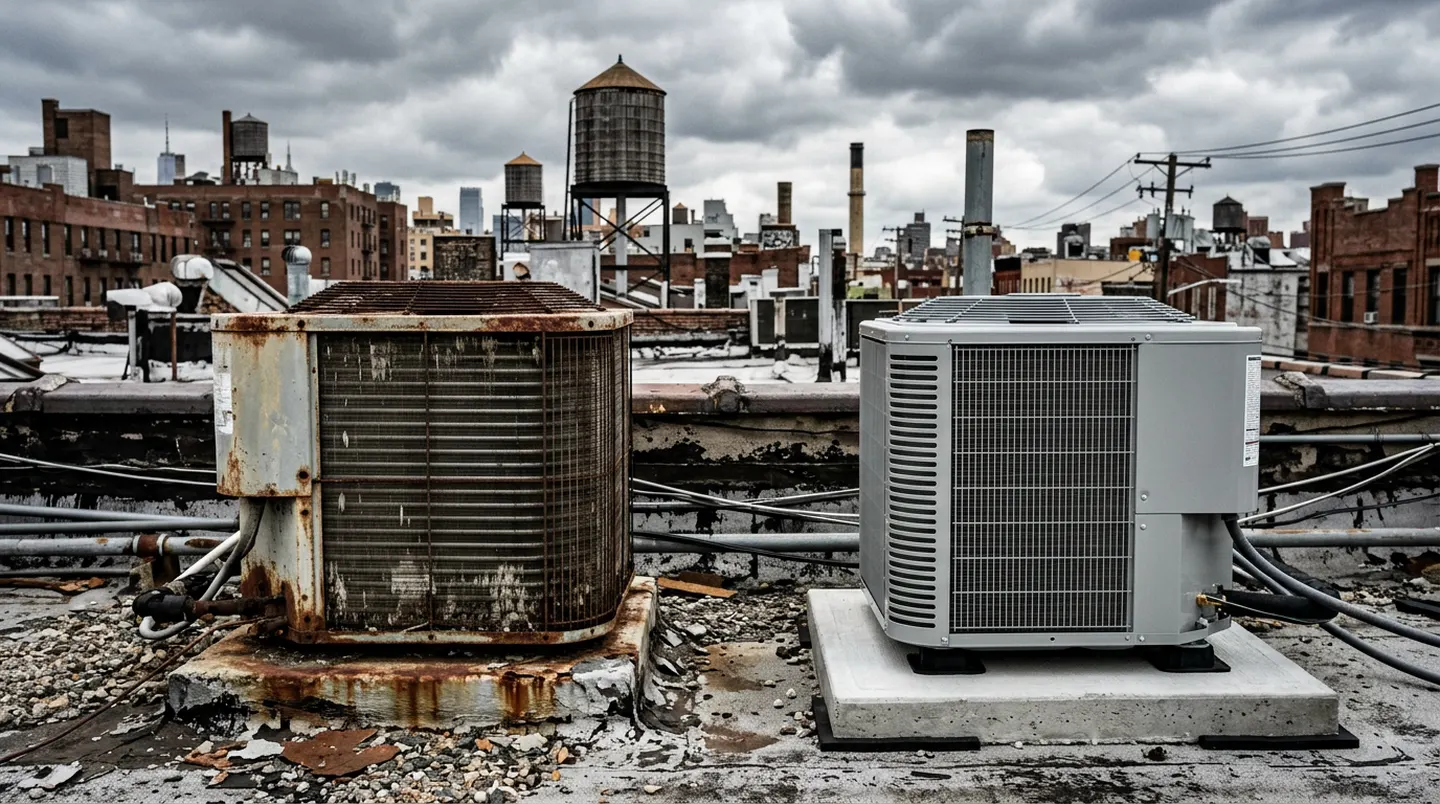
NYC adds practical stress. Rooftop condensers see sun, wind and restricted service access. Brownstone backyard units can collect leaves and debris. PTAC sleeves can hold moisture. Window units may be taken in and out each season, damaging panels or cords. In Queens, salt air is less of a factor than on the immediate waterfront but outdoor pollution, heat islands and poor drainage still affect condenser coils; see our Queens HVAC service coverage for local scheduling.
A good service record should show measured findings rather than only a list of parts. Refrigerant pressure, temperature split, amperage, airflow, drain condition and electrical observations help tell whether a problem is isolated or systemic.
The informal “50 percent rule” is a useful conversation starter, not a law. If a major repair approaches half the installed cost of a compatible new unit, it is reasonable to price replacement. But replacement may also require a new sleeve, circuit, pad, duct correction, building approval or line-set work. Compare complete installed scopes rather than comparing one repair invoice with an online equipment price.
Replacement becomes more compelling when a unit uses obsolete refrigerant, has repeated leaks, cannot maintain comfort after correct diagnostics, or needs several major components at once. Repair is often sensible when the fault is a capacitor, contactor, fan motor, thermostat, drain component or a limited electrical issue and the system otherwise performs correctly.
For a written repair-versus-replace assessment, an AC installation consultation can document capacity, access and replacement constraints alongside the repair recommendation. There is no benefit in changing a correctly sized system just because it has reached a round-number age.
Window units usually announce trouble through reduced airflow, ice, water leaks, breaker trips, loud vibration or a compressor that starts and stops. Clean accessible filters and verify that the unit is supported and draining correctly. If it still does not cool, do not puncture panels or attempt refrigerant work; the repair value depends on condition, capacity and unit age.
PTACs often show sleeve or condensate problems as well as chassis faults. Water on the floor, musty odor, a noisy indoor fan and poor heat are reasons to inspect the filter, coils, drain arrangement, controls and chassis fit. A repeated water problem can damage finishes before it becomes an obvious equipment failure.
Central AC and heat pumps benefit from earlier attention to rising electric use, long run times, weak rooms, abnormal cycling, oil marks near refrigerant components and recurring drain backups. Duct restrictions and thermostat placement can imitate mechanical decline. A diagnostic should separate distribution problems from compressor or coil problems before a replacement recommendation is made.
Replace or clean filters on the schedule appropriate to the system and household, keeping return grilles unobstructed. Keep outdoor condenser clearance free of bags, leaves and vegetation. Check condensate drainage before the first long cooling run. These steps protect airflow; restricted airflow can cause poor comfort, coil icing and stress on components.
A professional maintenance visit can check electrical terminals, contactors, capacitors, blower operation, coil cleanliness, refrigerant circuit indicators and drains. It cannot restore a worn compressor to new condition, but it can find a weak part before a hot-week failure. Consider scheduled AC maintenance before the busy summer period, especially for a system approaching the middle of its expected range.
Keep all work orders. For co-op and condo owners, those records also help explain to management what equipment was serviced, whether the sleeve or exterior work was touched, and why replacement may be necessary later.
New York equipment decisions are rarely made in an empty house. Before choosing an aging air conditioner, confirm the sleeve or window opening, electrical circuit, exterior work rule, elevator reservation and access route. A specification that works on a suburban plan can fail in a co-op if the board requires an alteration package, a licensed and insured contractor certificate, or installation only during weekday work hours.
For renters, the lease and building manager set the first boundary. For owners, the managing agent may also need cut sheets, insurance certificates and a plan for protecting corridors and elevators. Landmark-district façades, sidewalk sheds and backyard access can change a simple estimate into a coordinated job. These are planning items, not reasons to buy more capacity than the apartment needs.
The useful measurements are ordinary but specific: room dimensions, ceiling height, window direction, number of exterior walls, unit model and age, breaker size, and photos of the installation location. With that information, a technician can separate a repairable issue from a replacement decision and tell you what approval or access may be needed before work is scheduled.
Use a comparison as a decision aid, not a substitute for a site visit. Equipment labels, online prices and manufacturer efficiency claims do not include the condition of the existing sleeve, ductwork, wiring or condensate route. In an older Manhattan or Brooklyn building, those existing conditions can dominate both installation scope and noise performance.
Ask for the proposed model, the work included, any exclusions, the electrical requirement, condensate plan and who coordinates building access. If a bid assumes an existing disconnect, wall sleeve or sound pad is usable, that assumption should be written down. It makes two estimates comparable and helps avoid approving an equipment choice that the building cannot accept.
Maintenance is not a promise that a compressor will never fail. It is a way to find restrictions in airflow, loose electrical connections, drain problems and abnormal operating readings while a repair can be planned. A service visit should document what was cleaned or measured and identify a part that is showing wear; “tuned up” by itself does not say much.
NYC maintenance also has an access side. Roof doors, basement mechanical rooms, window guards, rear-yard gates and doorman logs should be arranged before the appointment. A technician who can reach the unit, isolate power safely and run it under load can make a useful recommendation. If the building will not permit that access, the quote should say what remains unverified.
A sound recommendation about an AC repair-or-replacement decision should leave a customer with clear next steps, not just a model name or a broad promise. Ask what was observed, what was measured, what assumption the recommendation uses, and what could not be inspected because of access. In an apartment building, the practical constraint is frequently outside the equipment: an unconfirmed electrical circuit, an occupied room, a roof key, a window-guard rule or a managing-agent requirement can stop a job that otherwise looked simple.
Separate the condition of the equipment from the condition of the installation. For example, a room unit may be mechanically serviceable but installed in a compromised opening; a central system may have a good outdoor unit but a restricted return; a heat-pump project may have a strong efficiency case but no acceptable location for winter drainage. Addressing those facts early gives the owner a more honest choice between repair, replacement, deferred work or a smaller correction that improves comfort now.
Ask the building for its current alteration, certificate-of-insurance, access and work-hour requirements before signing a delivery date. Co-op and condo rules change, and even similar buildings on the same block can have different procedures. If exterior work, a new circuit, a sleeve change or a roof placement is involved, identify who must approve it and whether the work has to be coordinated with a superintendent, managing agent, electrician or architect. Do not assume a past installation is a precedent for a new one.
On the day of service, make the equipment reachable and protect the surrounding area. Move furniture from returns and indoor units, secure pets, provide the correct apartment or roof access, and explain any history of leaks, breaker trips, noise or weak rooms. Clear information helps a technician choose the right tests instead of spending the first part of the visit locating equipment or reconstructing the symptom from a thermostat setting.
Finally, retain the written scope and any model numbers, readings or photographs supplied after the visit. These records are useful when a board requests documentation, when another phase of work is planned, or when a recurring problem returns next season. They also make it easier to compare future proposals on the same basis: capacity, access, equipment match, electrical scope, drainage, permits or building approvals, warranty responsibility and exclusions.
A well-maintained central AC is commonly planned for 12–18 years. Exposure, coil condition, airflow, repairs and maintenance determine whether an individual unit falls below or beyond that range.
Not automatically. Compare the diagnosed repair, refrigerant type, comfort performance and complete replacement scope. Age alone is not a diagnosis.
No. Window units generally have shorter planning ranges, about 6–10 years, because they are smaller seasonal appliances exposed to vibration, weather and storage handling.
It can prevent airflow, drain and electrical problems from being ignored and helps identify developing faults. It cannot make every major component last indefinitely.
Repeated refrigerant leaks, an obsolete refrigerant, a failing compressor or coil, multiple major repairs and inability to hold comfort after a correct diagnosis are stronger signals than age by itself.
A practical NYC buying framework for equipment type, placement and approvals.
Buying guidePlanning ranges for diagnostics, repairs and replacement decisions.
Cost guideA separate comparison for apartments considering a ductless retrofit.
Compare systemsReplacement planning that accounts for capacity, access and building requirements.
Preventive checks for airflow, drains, coils and electrical components.
Diagnosis for systems with weak cooling, noise or recurring failures.
Call (212) 201-9201 or send the symptom, building type and equipment through the quote form.