
How to choose the best air conditioner
A practical NYC buying framework for equipment type, placement and approvals.
Buying guideWinter HVAC care in NYC depends on what the equipment does. Learn when a condenser cover is appropriate, why an operating heat pump must stay open to air, and how to protect PTACs and drainage.
Certification and license records are available on request while our public verification page is in progress.
A cooling-only central AC condenser is normally idle in winter. A heat pump is not: it may need to operate through the coldest weeks, so blocking its airflow or covering it tightly can cause damage. PTACs remain in the wall and may provide electric heat or heat-pump heat, which makes drainage, outside air and sleeve condition important through freezing weather.
The right winter work depends on the model, the building and whether the system will operate. Start with the manufacturer instructions for the specific unit. A generic tarp is not a maintenance plan. It can trap moisture, rub against coil fins, become windblown debris and invite rodents. It is particularly inappropriate for an operating heat pump.
Before winter, identify which units are cooling-only, which are heat pumps and which PTACs are expected to heat occupied rooms. That prevents a staff member from covering or disconnecting equipment that residents rely on for comfort.
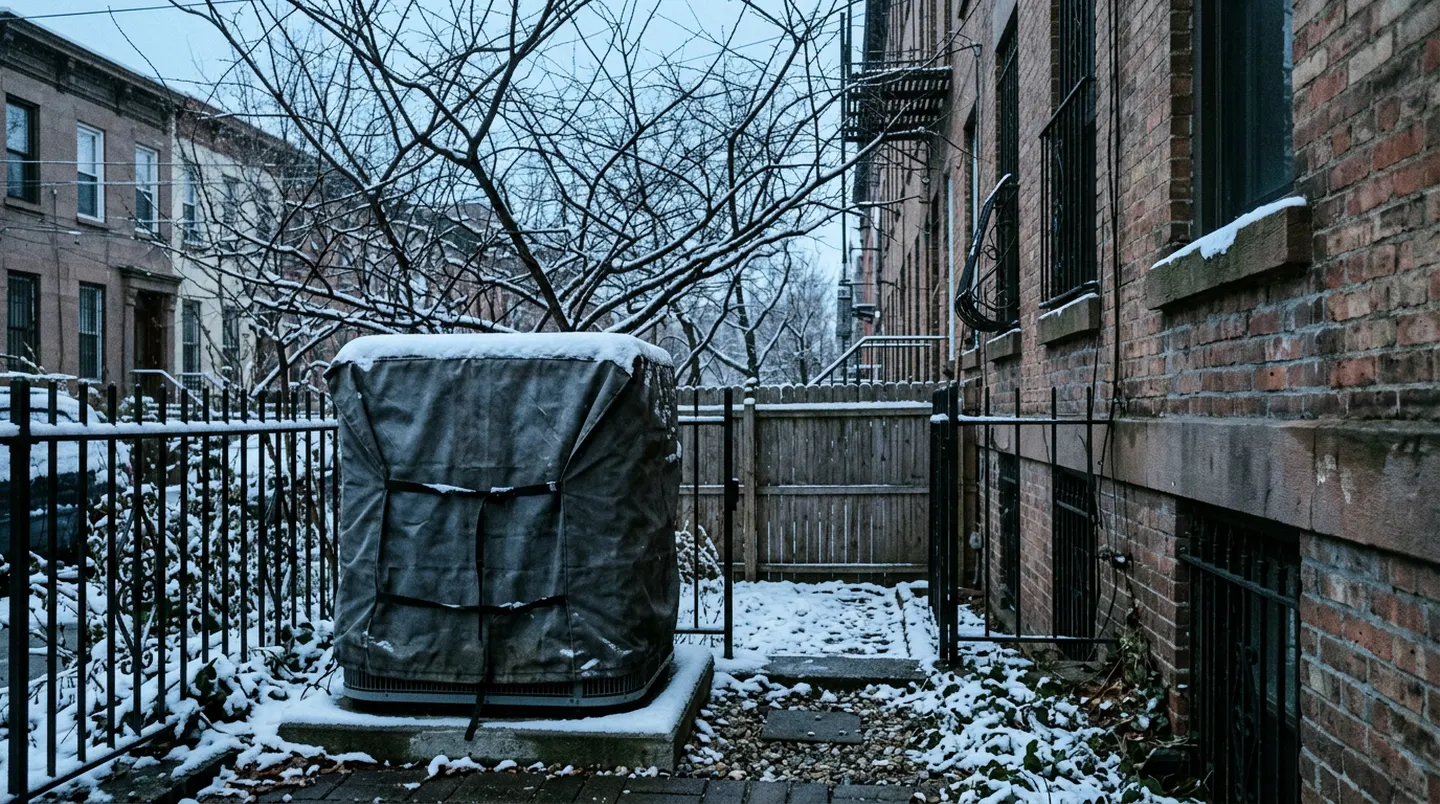
Most outdoor condensers are designed to sit outdoors. For a cooling-only unit that is off for the season, a manufacturer-approved top cover or protective cap may be appropriate where falling leaves or debris are a concern, but it should not wrap the entire cabinet tightly. Air needs to move through the unit to dry it. Follow model-specific guidance and remove any temporary protection before spring start-up.
A heat pump needs unrestricted air around the outdoor coil in heating mode. A full cover can interfere with airflow and defrost operation. Keep snow, leaves, bags and ice away from the unit, while maintaining the clearances specified for the equipment. Do not chip ice off coil fins or pour hot water into electrical areas.
For installations in a Brooklyn backyard, salt from nearby sidewalks and windblown debris can accelerate coil corrosion or block airflow. Our Brooklyn HVAC service coverage includes inspections where the placement, drainage and surrounding grade are more important than a decorative cover.
In heating mode, the outdoor coil can frost as it extracts heat from cold outdoor air. The heat pump periodically enters defrost to clear that frost. You may see vapor and water around the outdoor unit; those can be normal. The design challenge is where that water goes after it leaves the base pan. It must not build an ice sheet at a doorway, on a walkway or under equipment supports.
Keep the unit elevated and level as specified, with a stable base and an open drainage path. Check that snow accumulation and leaves do not crowd the coil. If the unit repeatedly becomes solid ice, makes unusual mechanical noise, fails to return to heating after defrost or produces an error code, arrange heat pump diagnostic service. Do not disable defrost sensors or force the system through repeated resets.
Indoor airflow remains essential in winter. A blocked filter or closed return can make a heat pump seem underpowered and can trigger protective behavior. Keep furniture away from indoor heads and return grilles, and use the thermostat or controller as designed rather than cycling power frequently.
PTACs are exposed at the wall sleeve. Their chassis, louvers, seals and condensate path need attention before freezing rain and wind arrive. Residents often notice a draft, water mark, poor heat or an unusual fan sound first. Do not stuff towels or foam into air openings that the unit needs for safe operation; report the symptom and identify the unit location for service.
A unit that provides heat-pump operation may also defrost. A unit with electric resistance heat has different behavior and electrical demand. The nameplate and control settings matter. Building staff should avoid assuming all PTACs in a property are identical, especially after piecemeal replacements over many years.
For a fleet, record chassis brands, sleeve sizes, voltage and recurring unit numbers. This speeds winter troubleshooting and helps plan replacement batches. For a single apartment PTAC, clean the accessible filter, keep the front unobstructed and seek service if water, ice, odor or electrical tripping appears.
Brownstone rear yards can be shaded and damp while roofs receive wind, snow and direct sun. A condenser installed low in a yard needs protection from leaf buildup and splashback without being boxed in. A rooftop unit needs safe winter access; a technician cannot make a meaningful inspection if the roof hatch, keys or fall-protection procedure are unavailable.
Salt used on walks should not be piled against outdoor equipment. It can be carried into coil areas by meltwater and accelerates corrosion. Direct runoff away from equipment where practical, and avoid storing bags, planters or garbage against the cabinet. The same clearances that help summer cooling are important in winter heating mode.
Schedule seasonal HVAC maintenance before persistent freezing weather if the property has a heat pump, multiple PTACs, a known drainage concern or an outdoor unit with difficult access. Early attention is less disruptive than a no-heat call when weather is severe.
Do not use a tarp, plywood enclosure, heat tape or drain modification unless it is compatible with the manufacturer instructions and the installation. Do not pour hot water into equipment, pry ice from delicate coil fins, or run a space heater against the outdoor unit. Those shortcuts can damage electrical components, create fire risks or hide the condition that needs diagnosis.
If a heating system is not providing safe indoor comfort, use the building’s established emergency process and seek qualified service. For AC Repair NYC, call (212) 201-9201; the emergency line is answered 24 hours. The office schedule is Monday–Friday 8:00–18:00 and Saturday 9:00–15:00.
New York equipment decisions are rarely made in an empty house. Before choosing winter HVAC equipment, confirm the sleeve or window opening, electrical circuit, exterior work rule, elevator reservation and access route. A specification that works on a suburban plan can fail in a co-op if the board requires an alteration package, a licensed and insured contractor certificate, or installation only during weekday work hours.
For renters, the lease and building manager set the first boundary. For owners, the managing agent may also need cut sheets, insurance certificates and a plan for protecting corridors and elevators. Landmark-district façades, sidewalk sheds and backyard access can change a simple estimate into a coordinated job. These are planning items, not reasons to buy more capacity than the apartment needs.
The useful measurements are ordinary but specific: room dimensions, ceiling height, window direction, number of exterior walls, unit model and age, breaker size, and photos of the installation location. With that information, a technician can separate a repairable issue from a replacement decision and tell you what approval or access may be needed before work is scheduled.
Use a comparison as a decision aid, not a substitute for a site visit. Equipment labels, online prices and manufacturer efficiency claims do not include the condition of the existing sleeve, ductwork, wiring or condensate route. In an older Manhattan or Brooklyn building, those existing conditions can dominate both installation scope and noise performance.
Ask for the proposed model, the work included, any exclusions, the electrical requirement, condensate plan and who coordinates building access. If a bid assumes an existing disconnect, wall sleeve or sound pad is usable, that assumption should be written down. It makes two estimates comparable and helps avoid approving an equipment choice that the building cannot accept.
Maintenance is not a promise that a compressor will never fail. It is a way to find restrictions in airflow, loose electrical connections, drain problems and abnormal operating readings while a repair can be planned. A service visit should document what was cleaned or measured and identify a part that is showing wear; “tuned up” by itself does not say much.
NYC maintenance also has an access side. Roof doors, basement mechanical rooms, window guards, rear-yard gates and doorman logs should be arranged before the appointment. A technician who can reach the unit, isolate power safely and run it under load can make a useful recommendation. If the building will not permit that access, the quote should say what remains unverified.
A sound recommendation about a winter HVAC protection plan should leave a customer with clear next steps, not just a model name or a broad promise. Ask what was observed, what was measured, what assumption the recommendation uses, and what could not be inspected because of access. In an apartment building, the practical constraint is frequently outside the equipment: an unconfirmed electrical circuit, an occupied room, a roof key, a window-guard rule or a managing-agent requirement can stop a job that otherwise looked simple.
Separate the condition of the equipment from the condition of the installation. For example, a room unit may be mechanically serviceable but installed in a compromised opening; a central system may have a good outdoor unit but a restricted return; a heat-pump project may have a strong efficiency case but no acceptable location for winter drainage. Addressing those facts early gives the owner a more honest choice between repair, replacement, deferred work or a smaller correction that improves comfort now.
Ask the building for its current alteration, certificate-of-insurance, access and work-hour requirements before signing a delivery date. Co-op and condo rules change, and even similar buildings on the same block can have different procedures. If exterior work, a new circuit, a sleeve change or a roof placement is involved, identify who must approve it and whether the work has to be coordinated with a superintendent, managing agent, electrician or architect. Do not assume a past installation is a precedent for a new one.
On the day of service, make the equipment reachable and protect the surrounding area. Move furniture from returns and indoor units, secure pets, provide the correct apartment or roof access, and explain any history of leaks, breaker trips, noise or weak rooms. Clear information helps a technician choose the right tests instead of spending the first part of the visit locating equipment or reconstructing the symptom from a thermostat setting.
Finally, retain the written scope and any model numbers, readings or photographs supplied after the visit. These records are useful when a board requests documentation, when another phase of work is planned, or when a recurring problem returns next season. They also make it easier to compare future proposals on the same basis: capacity, access, equipment match, electrical scope, drainage, permits or building approvals, warranty responsibility and exclusions.
Follow the manufacturer guidance. A cooling-only unit may allow a limited top cover for debris, but a tight full cover can trap moisture. An operating heat pump should not be covered.
Cold-climate heat pumps are designed to heat in cold weather when properly selected and installed. They need clear airflow, functional defrost controls and a safe drainage plan.
During defrost, vapor and water can be normal. Repeated heavy ice, error codes or loss of heating performance should be diagnosed.
Keep its filter and required air paths clear, inspect for drafts or water symptoms, and have the sleeve, drainage and controls checked if problems recur. Do not block vents with towels or foam.
Salt and salty meltwater can accelerate corrosion. Keep salt piles and runoff away from the equipment while maintaining manufacturer-required clearance.
A practical NYC buying framework for equipment type, placement and approvals.
Buying guidePlanning ranges for diagnostics, repairs and replacement decisions.
Cost guideA separate comparison for apartments considering a ductless retrofit.
Compare systemsSeasonal inspections for outdoor units, PTACs and drainage.
Diagnosis for defrost, airflow, control and heating problems.
Service for PTAC heat, drainage, noise and sleeve-related issues.
Call (212) 201-9201 or send the symptom, building type and equipment through the quote form.